
Waste and recycling for residents

Your residential waste service
The City currently provides all residential properties with a standard waste service, included in their rates. Service types vary depending on property type.
- 3‑bin Food Organics and Garden Organics (FOGO) system – for single dwellings (houses) and multi‑unit dwellings with up to five units.
- 3‑bin Garden Organics (GO) system – for multi-unit dwellings with more than five units, which generate garden waste.
- 2‑bin General Waste and Recycling system – for multi-unit dwellings with more than five units that do not generate garden waste.
The City of Perth offers a bi-annual residential verge collection for residents. Residential verge collections generally occur in March and September each year.
Transition to the 3‑bin FOGO system
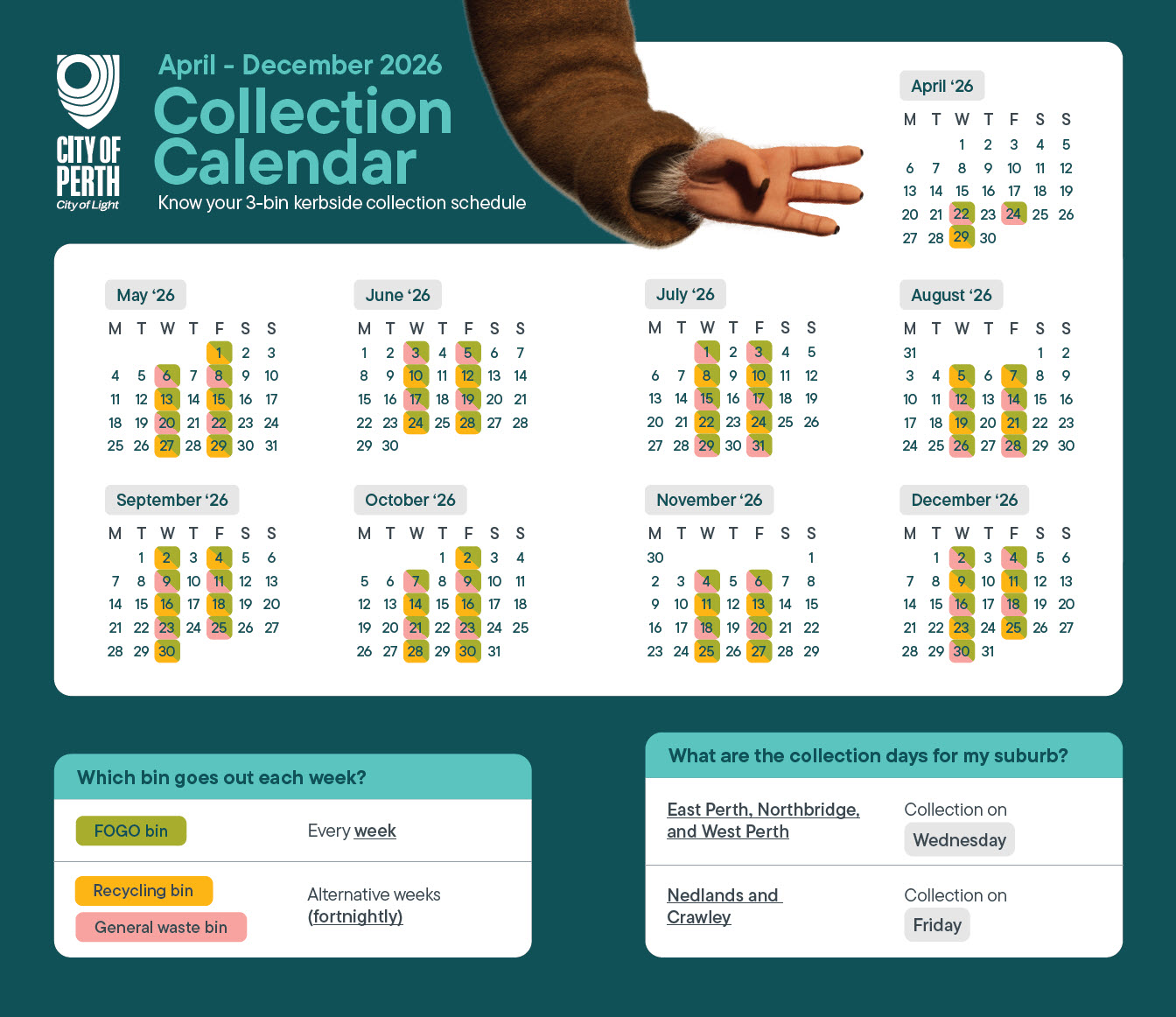
As of April 2026, the City has begun transitioning residential properties to the 3‑bin FOGO system. Residential properties not included in the initial phase of the rollout will continue using their current 2‑bin or 3‑bin GO systems, with no changes to their collection frequencies or days.
All FOGO-eligible properties have been notified via mail. If you are unsure whether your property is transitioning to the FOGO system, please contact the City. Full details about the City’s FOGO system, including what goes in each bin, collection frequencies, and rollout timing, are available on the dedicated FOGO information page.

General bin tips
- Place your bin out for collection in front of your property or in an alternate collection location as indicated by the City only
- Place your bin out well before your collection time to ensure it is collected
- Place all rubbish inside your bin and not next to your bin
- Ensure your bin weighs less than 70kg
- Close your bin lid to avoid windblown litter and vermin

Recycling information
The City is dedicated to continually increasing waste diversion from landfill. We need your help to make small changes to recycle correctly and reduce our overall waste. Does your building have recycling bins? Do you have too many or not enough bins? It might be time for an audit of your property’s waste services. Please contact the City to find out more about waste audits.
Ever feel confused about what items go into which bin? Want to know the disposal options available in your area? Search the City of Perth’s interactive map below.
-
Recycling – yellow lidded bin

This recycling service is supplied to all residents, businesses, events and in our public place recycling litter bins.
What can I recycle in my yellow lid bin?

How to excel at recycling:
- Use two bins in your kitchen, one for recycling and one for general waste.
- Recycle all glass (including broken glass), cardboard, paper, metal, aluminium, and hard plastics (i.e. punnets from berries or yoghurt containers). All other materials cannot be recycled in your yellow bin.
- Ensure all lids are removed from containers and bottles.
- Ensure all recycling is loose in your recycling bin and not in bags.
- All items that go into the yellow-lidded recycling bin need to be clean, dry, empty, and loose.
-
General Waste – red lidded bin
This General Waste service is supplied to all residents, businesses, events and in our public place general waste bins. Please remember the contents of this bin will be sent directly to landfill
What goes in my general waste - red-lidded bin?
- General rubbish
- Soft plastic packing (i.e., chip packaging, cling wrap etc)
- Meat trays
- Nappies
- Small lids
- Damaged clothing items that cannot be donated
- Hygiene products

-
Garden Organics (GO) – lime green lidded bin

The City offers a fortnightly Garden Organics (GO) bin service for households that produce garden waste. This service encourages residents to separate garden waste from general waste so it can be turned into compost and mulch, instead of going to landfill.
What can I put in my Garden Organics bin?
All garden waste from your garden can be placed in this bin, including:
- Lawn clippings
- Twigs and small branches
- Weeds
- Pruning and cuttings

-
Garden Organics (GO) collection days
The City conducts a fortnightly Garden Organics (GO) recycling service for residents. GO is turned into mulch and soil improver.
-
Containers for Change
The City of Perth is proud to announce its involvement in the State Government’s container deposit scheme, Containers for Change as the first CBD refund point in Australia.
The City of Perth offers a free collections service for businesses and apartment buildings with a full refund via your member number. Please email [email protected] to find out more.
For more information visit Containers for Change
-
Helpful resources
Stickers, Posters and Signs
We have a new set of stickers, posters and signs to help people sort their waste correctly. If you’d like some new stickers for your bins, or posters and signs for your bin area, email [email protected] or call 9461 3333.
Languages other than English
We also have posters in 15 different languages to help people sort their waste correctly. Each pdf has 2 pages. Page 1 is for those with a Food Organics bin and page 2 is for those with General Waste and Recycling bins.
Support for your waste services
-
What is my bin day?
To make it easy to remember your bin collection day, we have attached a sticker to the back of your bin. The sticker includes your address, collection day and the collection time.

If your bin is collected during the day, then your bin must be present at its service location by 6am. If your bin is collected at night, then your bin must be present at its service location by 8pm.
The exception to this is for some residents in West Perth. If your bin is serviced at night, your bin must be present in its service location by 4pm.
Bins are to be made available for collection no later than the time indicated above.
If your sticker has faded, please contact the City at (08) 9461 3333.
-
Residential bulk verge collection
The City provides a Bulk Verge Collection Service every 6 months for residents.
This special rubbish collection WILL REMOVE:
- Garden waste: Tree and shrub prunings up to 1.5m in length and up to 30cm in diameter, lawn clippings & leaves in boxes or bags
- Electronic waste: including televisions, computers, printers, phones, DVD/CD players, and Hi-Fi equipment
- Small electrical items: including kettles, toasters, vacuums
- Refrigerators/freezers (doors removed)
- Stoves and other white goods
- Mattresses
- Old furniture; and
- Other household items.
Please note: Garden waste, metals and mattresses are collected separately to be recycled. Other verge collection items are sent to the recycling sorting facility.
Hazardous Waste is detrimental to the environment and can damage our soils and water. As a result HAZARDOUS WASTE WILL NOT BE COLLECTED by the verge collection service. This includes paint, chemicals, gas cylinders, tyres, construction waste, vehicle parts, batteries etc.
This collection is for residents only and does not include commercial premises. Please contact the Waste and Cleaning Service Unit via [email protected] or (08) 9461 3333 if you have any queries.Recycling and reuse Information
Items collected during the verge collection are taken to a sorting facility to ensure as much as possible are recycled, however a lot cannot be recycled. Please assess all items for recycling and reuse options before putting them out for verge collection.
If it works someone could use it! Have you tried:- Asking friends if they need or could use the item?
- Contacting your local charity?
- Advertising the item for sale or for free on Gumtree?
- Posting on Facebook or other social media platforms to sell or give away the item?
Some local charities
Salvation Army 13 72 58 Vinnies 6323 7520 Good Samaritans 9463 0500
Red Cross 9225 8888 Save the Children 9209 2437 RSPCA 9209 9300 Verge collection tips
To make verge collection easier:
- Separate electronic waste, white-goods and garden waste into separate piles.
- Neatly place rubbish on the street verge.
- Trim tree branches/pruning to a maximum length of 1.5m. Larger branches will not be removed.
- Items should be of a maximum weight that is easily handled by two people.
- Use boxes or bags for lawn clippings, cuttings and leaves.
- Ensure items do not obstruct the footpath or your normal bin service.
-
Replacing or requesting extra bins
Residents with damaged or missing bins may obtain repairs or replacements from the City of Perth. Replacement bins and damaged components will be replaced free of charge.
If an additional or replacement bin (MGB) is required it must be obtained from the City by contacting us on (08) 9461 3333 or at [email protected].
Additional bins or services can only be provided with the written consent from the property owner, strata manager or the managing agent. Written consent must include complete address details and a full description of the additional services required.
All bins remain the property of the City of Perth.
To request a new or replacement bin please use a Request additional or replacement bins form.
-
Fees and charges
All residential properties include a standard waste fee included in their rates. This helps cover the collection and processing of all waste streams available to residential properties.
All residential properties on the 3-bin FOGO system will have:
- A 140L red lidded general waste bin, collected fortnightly.
- A 240L yellow lidded commingled recycling bin, collected fortnightly.
- A 240L lime-green lidded FOGO bin, collected weekly.
Non-FOGO residential properties currently have:
- A 240L red lidded general waste bin, collected weekly.
- A 240L yellow lidded commingled recycling bin, collected weekly.
Properties producing garden waste can request:
- A 240L lime-green lidded garden organics bin, collected fortnightly.
Multi-unit dwellings (apartment buildings) are encouraged to utilise 660L or 1100L bins instead of 240L bins. The advantages of using bigger bins instead of 240L bins include:
- Easier bin manoeuvring (with the four wheels they are easier to handle and have individual wheel braking).
- Fewer bins to clean, store and maintain.
- Fewer bins allow for better use of space for parking and storage.
- Less time service vehicles are parked outside businesses and blocking access.
Eligible pensioners might qualify for a 50 per cent discount on residential service charges. For more details, contact us at [email protected] or call (08) 9461 3333.
Please note that the below rates and charges apply for the 2025/2026 financial year. Please check back in July 2026, when the 2026/2027 fees and charges will be published, upon approval by Council.
Description Cost Basic Service (includes General Waste, Recycling, and Garden Organics bins) $371.70 Additional General Waste and Recycling bins – 240L $371.70 Additional Garden Organics bin – 240L $58.45 Additional Garden Organics bin – 660L $175.35 Return collection (for missed, overfull or contaminated bins) $53.75 -
Public holiday servicesPlease refer to this page for any disruptions to the bin collection service around public holidays.
-
Assisted household bin service
The assisted household bin service is a waste collection option for residents who cannot move their bins from their property to the kerbside for collection and back again each week. The collection driver will wheel the bins out from a designated pick-up point on the resident’s property and return the empty bin to the same spot. The assisted household bin service is provided at no extra cost beyond the usual service fee, provided the resident meets the specified criteria.
Application process
To apply for assisted bin service, you can complete the online Assisted Household Bin Service form, along with a copy of your medical certificate and current lease agreement, if applicable. Application forms will be assessed by the Waste and Cleaning Unit within 10 working days.
Test your waste sorting skills
Keeping the City of Perth clean
- 59 cleaning staff dedicated to sanitation, street cleaning and graffiti removal.
- 30,000 bins are emptied by the City of Perth each week.
- On average 200 tonnes of bulk rubbish removed from street verges annually.
- On average 12,900 square metres of graffiti is removed from city buildings and infrastructure each year.
- The City of Perth has seven street sweepers to keep roads and footpaths clean:
- CBD & Northbridge: roads and footpaths are swept seven days per week
- East Perth and West Perth: Roads are swept two days per week, footpaths are swept five days per week
- Broadway/Hampden Road: Roads are swept two days per week
- The City increases this service to address seasonal fruit drop
- A general washdown of Northbridge and the CBD takes place seven-days per week across 11 shifts (day and night)
- CMAR pressure cleaners are used by the City of Perth daily to remove oil, dirt, grime and organic material across the CBD and Northbridge at scheduled intervals throughout the night shift.
- Three dedicated cleaning staff to cover the city mall space all day, seven-days a week.
Waste management and tips
-
Waste minimisation information
In 2014-15 Australians generated 60 million tonnes of waste per year. This includes waste from our kitchens, bathrooms, laundries, gardens, and from building and construction activities. Although we've made great improvements in our waste disposal habits over recent years, we can always do more.
Below you will find some opportunities to try and minimise your waste generation. By being more selective with what you buy you can also encourage businesses to be more mindful of their business practises.
Refuse
- Choose reusable whenever possible. Think BYO cups, bottles, cutlery and picnic plates, reusable shopping bags, rechargeable batteries, even reusable straws.
- Say no to the big four - plastic water bottles, straws, coffee cups and plastic bags. Go reusable.
- Take your reusable coffee cup to cafes that support the reuse movement. Find participating cafes to get 20-50c off your coffee.
- Think twice before printing. Go for recycled paper when you must have a hard copy, and reuse those scraps in a handmade notepad.
- Say no to junk mail! Avoid all that paper waste with a No Junk Mail sticker and if you don’t use phone directories, cancel your home’s delivery.
- Switch to paperless billing wherever possible.
- Refuse single-use plastic and bring your own containers to takeaway restaurants.
- Buy e-books or visit the library instead of buying paper books.
Reduce
- Reduce the amount of chemicals and plastic waste in your home by making your own natural cleaners. Mix one part water with one part vinegar and a squeeze of lemon juice for an effective all purpose cleaner. Switch your thinking has a great guide for cleaning naturally.
- Try package-free grocery shopping at local bulk food supply stores. Buying in bulk doesn’t have to mean buying a lot, take your own containers and buy only what you need.
- Cut down consumption. Buy nothing new for a day, a week or month.
- Pack a ‘nude’ lunch before work. Save on packaging waste and expensive bought lunches.
- Make your own soup, yogurt, bread and salad dressing to cut down on plastic waste.
- Cut down food waste by meal planning for the week. Get more for your money, get the nutrition you need and use what you buy. Love Food Hate Waste has a guide for saving money, time and food.
- Cut down food waste at the end of each week by checking your fridge for unused fresh food and search for recipes to use up all your leftover food. If you can’t think of ideas search for recipes on the internet or use Love Food Hate Waste’s leftover lookup to find how to use your leftover ingredients.
- Cut down food waste at the end of each week by checking your fridge for unused food. If you don’t have time to cook it make sure you freeze it! You can freeze milk, cheese, vegetables and fruit. Love Food, Hate Waste have a freezer hero guide you can reference.
- Reduce the amount you need to buy by choosing durable, high quality goods.
- Check if you can borrow an item from a neighbour, friend or family member before buying it for yourself. Use Facebook to connect with your neighbours and share rarely used items.
Reuse
- Choose recycled or upcycled. Try a vintage shop for your next clothes purchase or upcycle a gift for your friend’s birthday. By buying goods that have recycled material you are supporting the recycling industry, the circular economy and more jobs!
- Help your building. Talk with neighbours about your sustainable living switches or set up a swap-and-share board for your strata.
- Make do and mend. Before replacing that holey jumper, have a go at darning or upcycling to get new life out of stuff you already have. If you need help find a repair café such as Perth Repair Café.
- Recycle everything you can. Take good quality unwanted items to a local op-shop or save them up for the Planet Ark's Big Aussie Swap during National Recycling Week.
- Re-home. Use op-shops or sites like Gumtree and Freecycle to re-home unwanted household items from clothes to collectables and puzzles to plants. Join your local Buy Nothing group on Facebook.
- Repurpose. Before throwing it away, think of how it can be put to use a different way. Old clothes and linen make great dusting rags, chipped coffee cups make great indoor plant pots and an old suitcase can even be repurposed as a dog bed!
Recycle
- All clothes placed in your recycling bin will end up in landfill. They also get tangled in the sorting equipment at the recycling facility and cause havoc! To recycle clothes and other textiles please take them to your local charity or charity bin. These organisations can raise profit for their worthy causes by reselling the items in their op-shops or sending them to be made into rags. Reuse is always better than recycling.
- Gas cylinders and butane canisters can’t go into your recycling bins. They are hazardous to the sorting equipment and the hard working staff at the recycling facilities. Please take all your hazardous goods including gas cylinders and butane canisters to your local transfer station for proper disposal. See Drop Off Facilities for more information.
- Batteries can’t be placed in any of your household bins. In Perth, they can be recycled at Council House, Citiplace Community Centre, Ross Memorial Church, and Perth City Farm. Some local councils have drop off locations in many local libraries and shopping centres.
- Anything with a power cord cannot go in your household bins. Please take all your hazardous goods including e-waste to your local transfer station for proper disposal. See Drop Off Facilities for more information.
- All cardboard should be flattened before it goes into your recycling bin. This ensures it can be easily sorted in the recycling facility. Please help the sorting staff at recycling facilities by flattening all your cardboard (big and small) before it goes into your recycling bin.
- All containers must be empty and reasonably clean before going into your recycling. The easiest way to clean dirty containers (like yoghurt) is to use the dirty dishwater once you have finished washing your dishes. Saving water and recycling right.
- Use your yellow top bin for all your recyclables and remember not to put them in plastic bags which can jam recycling machines.
- Compost food scraps. Bokashi buckets and worm farms work well for small urban spaces, and every 1kg of food ‘recycled’ saves 1kg of greenhouse gas emissions. If you’d like some useful fact sheets visit Mindarie Regional Council or Planet Ark.
- Recycle right. Recycle batteries at Citiplace Community Centre, Council House or Ross Memorial Church, and take chemicals and paints to Balcatta Recycling Centre.
More resources
-
Drop off facilities
City of Perth residents can use four Council drop off facilities and one Community drop off facility.
- Tamala Park, 1700 Marmion Ave, Mindarie, (08) 9306 6303
- Recycling Centre Balcatta, 238 Balcatta Road, Balcatta, (08) 9205 8555
- City of South Perth Recycling Centre, Hayman Rd, Como WA 6152
- West Metro Recycling Facility

A maximum of 20L/kg (or combination) per visit applies. Bulk recycling and general waste can also be dropped off anytime.
Reusable or recyclable items
All council drop-off locations accept a wide range of items that can be resold or recycled. This is offered as a free service to residents. Items accepted include clothing, glass items, household goods, carpet, firewood, crockery and cutlery, paint, gas bottles, electronic items including computer hardware and mobile phones, household chemicals, paper and cardboard, vegetable oil, batteries, engine oil, petrol, aluminium cans, steel cans, other items with a high metal content, and some building materials.
There are tip shops at Tamala Park and Recycling Centre Balcatta that offer pre-owned goods for sale, at bargain prices.
Landfill/general waste
All council drop-off locations accept landfill/general waste and household rubbish from residents. Fees apply for this service. A Schedule of Fees can be found on each facility's website.
Asbestos
Tamala Park offer a regular free asbestos drop off day for residents. Contact Mindarie Regional Council for information on drop off days, quantities of asbestos accepted, instructions for wrapping and delivery, and safe work procedures for the removal and handling of asbestos.
eWaste
All drop off locations accept eWaste at no cost and ensure it is properly recycled. Products accepted include computers, monitors, notebooks, printers, fax Machines, scanners, desktop-sized printers, CD drives, hard drives, TVs, VCR players, projectors, networking equipment, cables, keyboards, mice, floppy discs, printer cartridges, electronic games/toys, DVD players, stereos, cameras, video cameras, iPods, office photocopiers.
Household Hazardous Waste
Each of the facilities listed accept Household Hazardous Waste at no cost. Up to 20 litres or 20kg.
-
Household hazardous waste
This waste is hazardous to the environment and should not be placed in any of your bins!
- Anything with a power cord/e-waste
- Paint and chemicals
- Asbestos
- Gas cylinders
- Printer cartridges
- Construction waste (cement, bricks, rubble, sand)
- Tyres
- Smoke alarms
- Vehicle parts
- Household lights.
The WA Government's Waste Authority website has detailed information on dealing with and disposing of hazardous waste. These items can be disposed of at two drop off facilities, Tamala Park and Recycling Centre Balcatta.
Battery recycling
Residents can drop off dry cell batteries at the following City of Perth locations:
- Woolworths Murray Street - 166 Murray St, Perth WA 6000
- Woolworths St Georges Terrace - 100 St Georges Tce, Perth WA 6000
For more information, visit https://bcycle.com.au/resources/faqs/
Other ways we help
-
Street cleaning
The City operates an intensive nightly street cleaning operation from Victoria Avenue to Milligan Street, east to west and from St Georges Terrace to Aberdeen Street, south to north.
Daytime street cleaning in the central city is carried out using small mobile mechanical cleaners. Areas outside the central city are cleaned using ride on mechanical cleaners. The City has a high-pressure cleaning process which incorporates a fine water spray. This enables stains and spillages to be removed. -
Noise Management Plan (NMP)
The City of Perth engaged Lloyd George Acoustics to prepare a Noise Management Plan (NMP) for the City's Waste and Cleansing Unit, to minimise the noise impact for waste collections and street cleaning to sensitive receivers from out-of-hours essential services carried out by the City of Perth within its boundaries.
This allows the City to conduct essential services more efficiently, such as:
- Cleaning the streets after events and weekend nightlife activities in the CBD and Northbridge, ensuring the City is ready for breakfast trade the next morning.
- Collecting waste and recycling outside of peak vehicle times, decreasing traffic congestion, and increasing staff and public safety.
Sanitation and street cleaning
Sanitation services includes the collection of landfill waste, commingled recycling and cardboard. These services run every day at the following times:
- CBD, Perth 6000/Northbridge 6003 (Sun-Thurs): 9pm-3am
- CBD, Perth 6000/Northbridge 6003 (Mon-Fri): 6am-3pm
- CBD, Perth 6000/Northbridge 6003 (Fri/Sat): 9pm-3am
- CBD, Perth 6000/Northbridge 6003 (Sun): 2am-9am
- East Perth 6004 (Mon-Fri): 6am-3pm
- West Perth 6005 (Mon-Fri): 4pm-12am
- Crawley/Nedlands 6009 (Fri): 6am-3pm
Street cleaning works include sweeping, manual and high-pressure cleaning of roads and footpaths in the following areas:
- CBD, Perth 6000/ Northbridge 6003 (Sun-Thurs): 9pm-3am
- CBD, Perth 6000/ Northbridge 6003 (Mon-Fri): 6am-3pm
- CBD, Perth 6000/ Northbridge 6003 (Fri/Sat): 9pm-3am
- CBD, Perth 6000/ Northbridge 6003 (Sun): 2am-9am
- East Perth 6004 (Mon-Fri): 6am-3pm
- West Perth 6005 (Mon-Fri): 4pm-12am
- Crawley/Nedlands 6009 (Fri): 6am-3pm
The City of Perth Essential Services Noise Management Plan was approved and endorsed by the Department of Water and Environmental Regulation (DWER) on 15 May 2025. View the document here.
See also
Downloads
- Household Hazardous Waste Flyer508.69 KB | PDF Document